Girl in Dang

I was following a Maoist politician on his campaign rally in western Nepal when this girl caught my attention. She had a certain kind of look in her eye that one just cannot forget. A penetrating kind of gaze and gazes back at the viewer again and again.
Nepal in Numbers
By Edwin Koo
2010/07/22
If someone asked me to describe Nepal today, I would be tongue-tied, simply because of the rainy, mucky mess it’s in. To make matters worse, political idiots like me are getting entangled by the big words like “consensus” and “majority” governments. I’m sure these kids as confused as I am.
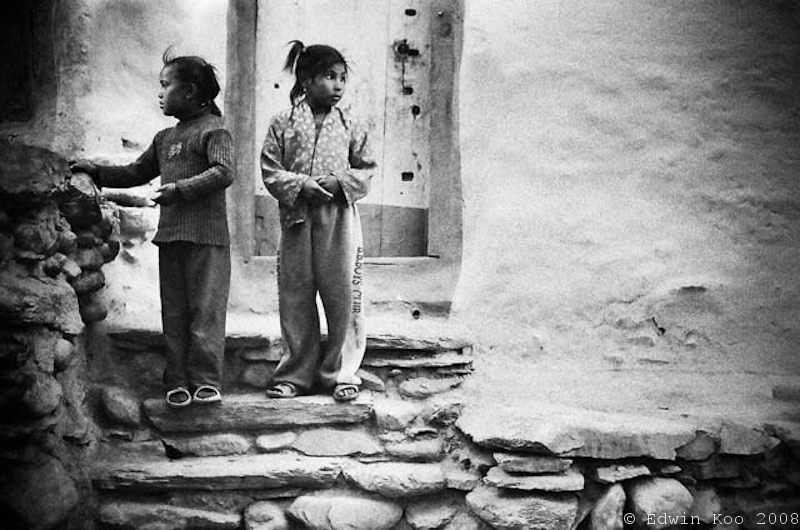
Nothing much has improved since this picture was taken in March 2008, , except that the political stakes with which politicians wager with, which includes precious funds and time for development.
So I thought the best way is to use numbers to re-organize a little.
Here’s Nepal in Numbers, in a nutshell:
- Madhav Kumar Nepal resigned on 30/06/2010
- The political parties tried to form a consensus government and agree on a new Prime Minister. They missed 2 deadlines in 2 weeks. By 13/07, President Ram Baran Yadav says forget consensus, we go for majority (what’s that again?)
- Nepal’s 601-member Constituent Assembly (which doubles as a Parliament) goes to the voting box to elect a new Prime Minister on 21/07/2010, but there was no majority, so no new Prime Minister
- Why no majority? The next Prime Minister needed a 301-300 margin to win.
- There were 3 candidates in the race: Pushpa Kamal Dahal (Prachanda) from the Maoists, Jhalanath Khanal from the UML, and Ram Chandra Poudel from Nepali Congress (NC).
- Prachanda got 242 out of 592 votes
- NC’s Paudel had 124 votes in his favour
- Jhalanath Khanal (UML) pulled out, leaving 2 candidates to slug it out. As a result, the election postponed 2 days
- Why did the UML pull out? Because they had 0% chance of winning.
- Maoists have 237 seats (39.4%). UML has 108 (17.9%). NC has 114 (19%).
- The wildcard, really is the Madhesi alliance of parties, which hold 82 (13.6%) seats. Madhesis belong to the Terai plains, and have been long excluded from politics until 2006. They have stayed “neutral” till now.
- So the Maoists really need the Madhesis to have “majority”. 237+82= 319!
- Of course, neither the UML nor the NC wants that to happen. Even if UML and NC join hands, that’s 114+108= 222 (36.9%). So everyone’s wooing the wildcard underdogs, in order to become top dog once again.
- So now we see why Khanal (UML) decided to stay “neutral”. Being neutral means being the 82+108= 190 (31.6%) who can have a higher chance of winning the gambit. In short, it’s not easy to be King, but easier to be king-makers
- And since the King needs the makers more than the makers need the King, then being king-maker gets you the best bargain. So I expect the king-makers (UML and Madhesis) to be extracting at least 1 pound of flesh from the next King… er hmmm, I mean, Prime Minister.
- In the meantime, while all these numbers are being crunched:
- 49% of children under 5 suffer from stunting
- 26% of rural population have decent toilet facilities
- Average income remains at slightly more than US$1/day
- 1 million people in Kathmandu and many more millions outside the capital struggle to get drinking water everyday
That’s Nepal for you, in numbers. Questions, anyone?
Monsoon Madness
By Edwin Koo
July 17, 2010
These days, I find myself complaining about the rain. The monsoon has arrived, very often filling the khaaldos (potholes) with mucky water. Riding a motorbike in the monsoon is often a very wet experience, even with your raincoat on. If you don’t get wet from above, you get wet from below.
Perhaps, it’s symptomatic of Nepal. If Nepal was a bhato (road), it is one pothole-ridden dirt track, squishy with muck. And since it’s the only road around, everyone gets wet and muddy.

Workers clear the choke in a sewage outlet in Dhobighat, Lalitpur. Most of the drainage system in Kathmandu are unable to cope with the sudden increase in rainfall during the monsoon season. Nepal. 2010/07/11.
Of late, the road to “peace” has become the most bumpy of rides since Nepal became the world’s newest republic in April 2008. It was first signaled by the expiry of the May 28 deadline – when a new Constitution was supposed to have been born. Instead, the so-called leaders of this country decided to strike a new deal – and extended the term of the 600-member Constitutional Assembly by a year.
A month later, Prime Minister Madav Kumar Nepal surprised everyone by resigning, leaving the “peace process” in limbo, and leaving everyone to guess what kind of political chess move he was trying out.
Then came the national sport called “extending the deadline”, made popular by the anti-climax of a historical milestone of May 28. On July 1, President Ram Baran Yadav told the political parties to get together, have a nice picnic, shake hands, exchange hugs, make peace, and agree to team up to form a new consensus government.
To be exact, Yadav gave them a week to do these things. When 7 July came, the parties missed the deadline. Yadav plays nice, tells the boys to try again for the next five days. 12 July came, and still no consensus.
The parties are still haggling over the same “issues” since 2006- how to rehabilitate the Maoist fighters, what to do with the Youth Communist League cadres, and how to deal with the forced seizure of properties, etc. Actually, to cut through the clutter, the main issue is, “who gets to be Prime Minister”.
So Yadav finally decides to call a spade a spade, and tells the parties to elect a new Prime Minister by 21 July. It doesn’t have to be a “consensus” government anymore, Yadav says, since pleasing everyone is impossible. Instead, let’s go back to the “majority” government system, in which “winner takes all”, so the boys can have some mud-slinging fun while they slug it out.
So in 2 months, we have had 4 extensions of deadlines, a resignation of a Prime Minister, and a full-blown circus show of bickering politicians, which unfortunately, occupies many pages in the daily newspapers.
In the midst of this impasse, the Finance Minister managed to table a truncated budget of NPR 110.21 billion to keep the government running. The Foreign Ministry also managed to award the Machine-Readable Passport tender to a French company, much to the ire of Big Brother India.
In fact, such important matters are keeping the ministers so occupied, there is really not much time to consider the perennial food crisis, caused mainly by market manipulated inflation. And where is there time to look into the drinking water crisis, both in Kathmandu and far-flung places like Illam? Moreover, who would have time to look at the issue of forestry officers deforesting Eastern Nepal (wasn’t that their job description?)
As Nepal wades helplessly in a monsoon season of anarchical chaos, it is no surprise that a Maoist commander decides to go rogue again, robbing Chinese merchants in broad daylight. And that Maoist fighters can die mysteriously when they are supposedly under the “protection” of the United Nations.
Meanwhile, the “peace process” has once again, become “in peril” for the umpteenth time. By the way, what is a “peace process”? A euphemism for “we’re trying to make things right, but we’re still trying to figure out how”?
While the foreign consultants and pundits are busy administering their “cures” to the problem, “peace” will remain elusive, because the honchos in charge aren’t exactly concerned about real peace.

Tens of thousands of ordinary Nepalis took out a peace rally on May 07, 2010 to call for a resumption of daily life following a week-long Maoist bandh.
Paani… chhaina? (No water?)
By Edwin Koo
30 June 2010
The monsoon has begun.
Almost every afternoon, rain would descend as butter-bean-sized drops, pelting hard on the unsuspecting pedestrian caught in its sudden outburst. Welcome: “bad” laundry days.
Still, the monsoon is an apt reminder that we live in the second most water-rich country in the world. Fed by the Himalayan glaciers, mighty rivers feed this country, as well as the entire Indian subcontinent, where a quarter of the world lives.
What may surprise most people then, is this: Katmandu is a thirsty, parched city. The irony is not lost on its 1 million inhabitants, whose taps are dry 90 percent of the time, and water comes in tankers, twice or thrice a week, depending on where you live.
And when such a tanker appears (quite literally, because there is no fixed schedule), chaos ensues. Locals would troop back with containers of every assortment – used lubricant canisters, used paint buckets, and used Coke PET bottles. A riot of colours is only matched by the riot of protests. “Why are you not queueing up?” one would shout. “Hey, you’re taking forever! Its my turn!” another would yell.
They looked like a hundred hungry calves, fighting to suckle on a lone mother’s udders.
It had become an everyday scene in Katmandu, melding into the social consciousness of the easy-going Nepalis. What appeared as a jarring problem that started years ago, had become a way of life, melding into the background. The residents have gotten used to it, save a few grouses.

Residents jostled for water as a 6000-litre water tanker arrives to provide water to its thirsty clients.
But to a foreigner and a photographer, the reality cried out like an absurd scene from a bad comedy.
It’s hard to imagine that water was once a free resource in the Valley of Gods.
Before there was multi-party democracy, there was free water.
The monarchs, no matter how fatuous, made sure that public water taps were built. Hithis, or aqueduct outlets, flowed with so much water that it was painful to stand under one. The same hithis are dry now, thanks to mismanagement of water sources.
Of course, there is the much-vaunted Melamchi project, started in 1998 as an initiative to supply Katmanduites adequate water with its targeted completion back in 2006/2007. Today, it is still incomplete.
The government project was doomed to fail, its fortunes tumbling along with the political state of Nepal. Presently, experts say it will not complete even by 2013. Ironically, even if it completes by 2012, it would not supply enough water to the burgeoning population of Katmandu. Urban migration is simply outpacing urban planning and development, if there’s any to speak of in the first place.
And as if water shortage was not enough of a problem, over 47 percent of the piped water supplied to households is unfit for drinking. It is not uncommon to see brown, muddy water belch from public taps.
To make matters worse, upper-middle class households that can afford electric water pumps are piping ground water illegally, reducing the level of the ground water table, increasing the salinity of the soil. Bottled water suppliers are probably the only ones laughing their way to the bank, but even then, 17 of the 37 bottlers in the capital have failed basic tests by government agencies.
As the absurd black comedy plays on in Nepali everyday life, residents are taking showers in stagnant ponds, washing their laundry at murky rivers, and queueing up at public taps at 2am to get substandard potable water.
And we’re not talking about a forgotten backwater village. We’re talking about Katmandu, Valley of Gods, capital of Nepal.
What now, Nepal?
By Edwin Koo
03 June 2010
It’s been five days since they extended the term of the Constitutional Assembly, and Nepal has, well, returned to state of normalcy.
Meaning the newspapers are once again, filled with stories of bickering politicians making threats and counter-threats, calling each other names and blaming each other for the failures so far. Oh yeah, and the conspiracy theories. Who doesn’t love a juicy conspiracy? That’s normalcy in Nepal.
The daily media, it seems, has a fixation with what politicians say, even if they are all saying the same thing – which eventually, says nothing.
About a week ago, when my American friend asked me what I thought would happen to Nepal after May 28 deadline of the CA, I had no answer. Gosh, I couldn’t even punditrify (borrowing George Bush’s vocab). Feeling a little stupidified (thanks, Bush, I love your vocab) that I couldn’t even hazard an educated guess after 1.5 years in Nepal, I scoured through the dailies to try to find an answer.
I should have looked elsewhere. Anywhere.
The news was filled with punditry of every sort, which probably left the reader more confused before he opened the papers. Here are an example of that punditry:
“With the top three parties failing to come to an agreement on the Constituent Assembly (CA) extension, the country stands to face multiple possibilities – some of them catastrophic.” – Kathmandu Post, May 27, 2010. Page ONE
I was looking forward to seeing what the journalists had to say about the possibilities, especially the “catastrophic” ones. I found more questions than answers. I don’t blame them, since the story was peppered with political rhetoric like this:
“All these issues will likely take time for negotiations and there is every possibility that the parties may adopt intractable positions, leading to renewed stalemate.” – unnamed Nepali Congress leader, quoted in a page one story
Wow, I didn’t know you could “renew” a stalemate, and really, negotiations should “take time”, unless you’re bargaining with a vegetable seller.
All in all, the “crisis , catastrophe and consequences” (or whatever you call it) of a “dead” CA, seem to have been a big media exercise. No one was certain what would happen if the CA was terminated. Or if the CA was extended. Not the Maoists. Not the UML or the NC, and certainly, not the journalists.
As Nepali Times journalist Dewa Rai rightly pointed out: “Truth be told, we haven’t been here before.”
But one thing for sure, the Nepali people are paying for this foul-up. It has already cost Nepal Rs. 1,39,25,32,896 (USD$18.6 million) to shore-up the 2-year-old CA. The 601-member circus… I mean, Constituent Assembly, costs 57,000 rps for each troupe member every month. Sure, most of this moolah comes from “good-meaning” donors who take pity on the fledgling republic. But don’t forget, there is no free lunch, especially when it comes to diplomacy.
You can be very sure that what the donors give Nepal today will be returned as a proverbial pound of flesh tomorrow. It could be anything – trade concessions, political arm-wrangling. We don’t really know, but it will cost.
So before we talk about air-fairy consequences of what the Nepali leaders are squandering away today, let’s examine the real daily hardship that Nepalis have to endure. Problems like load-shedding (or power outage), water shortage and unemployment will not go away with punditry and bickering.

A shop remains open using candlelight, as the whole street was plunged into darkness during load-shedding. The photo was exposed for a few seconds, so that the image can show what the naked eye can't see. In short, the reality is darker than it seems. 😉
To put everything in perspective, let’s compare Kathmandu to one of the worst places in the world to be in right now: Gaza. The narrow strip of territory with 1.5 million population (rather similar to Kathmandu) has been blockaded by Israel for three years since the Hamas takeover. Gaza has 35- 60 hours of load shedding. Nepal, at its worst, had 84 hours. Currently, we have 42 hours, thanks to the summer rains.
So, if I may just suggest to Mr Nepal (or “Makune” – short form of Madhav Kumar Nepal – as the current Prime Minister is “affectionately” known by): could we get it over with the CA debate and talk about the real issues?
The real crisis, I’m afraid, will not descend upon Nepal today, but in the near future, when Kathmandu slips further down the rung of The Economist’s “Worst Cities to Live in” tally.
Chhaina, Nepal, Chhaina
If you’ve been to Nepal, one of the words you would have come across is “chhaina”.
The first time I heard that word was at a Maoist rally, so naturally, I thought the Maoist leader was in such awe of Mao’s motherland that he would pepper his speech with “China”.
Days later, I would finally find out the meaning if “chhaina“: “don’t have“.
And that’s exactly the situation Nepal finds itself in after the May 28 deadline for a new constitution: chhaina. The 600-plus-strong Constitutional Assembly, voted into power by the people of New Nepal, have failed to deliver the deal, two years after they were elected. At 11:43 pm, 17 minutes before the expiration of the term of office, the bickering politicians finally agreed on two things: 1. They disagree on too many things. 2. But what the heck, we will extend the term of the Constitutional Assembly by one year.
International media once again did not hesitate to call it a “political crisis” that could “derail the peace process“. Dire warnings of possible consequences as the midnight approaches filled cyberspace. As top leaders sat through see-saw negotiations from 8am, protesters burned effigies, armed police were put on super-high alert, and a bomb hoax at the main gate of the CA building ended the day of high drama with a masterful stroke.
All in all, it was a historical day.
Or rather, it was supposed to be one, since the world’s newest republic was supposed to get its Constitution – the sacred document representing the people’s will. A true mark of a real democracy.
But it was not to be. Rather than delivering the real deal, it was to be a big wet fart. Still, the powers that be had to shake off the embarrassment by keeping the audiences on the edge of their seats, creating a historical day from an anti-climax, to distract the people from the real issue at hand.
Ironically, the smokescreen wasn’t even necessary. In the streets next to the CA building, hawkers peddled sekuwa (skewered BBQ meats), slippers, clothes, and emergency lights. The sidewalk was choked with pedestrians, as half the road had been cordoned off as a safety buffer. I had called my friend to ask about the news on TV, and his reply was: “Ma ahile bahira.” (I’m out right now). And no, he wasn’t photographing the “historical day”. It was after all, Friday night.
As I patrolled the perimeter of the Birendra International Convention Centre (BICC), where the CA members hold office, I couldn’t help but wonder if the only people who really cared about the consequences of this looming “political crisis” were cadres and journalists. Beyond the newly-erected concertina wire-fence, two girls were sitting picnic-style on the grass, chatting away outside the walls of the CA.
By 8pm, my photographer friends from the wire agencies had come out of the CA building premises, and started taking pictures of security forces stationed outside the perimeter. When photographers are so bored they start taking generic pictures, you can be quite sure the news today certainly wasn’t so newsworthy.
For all the well-orchestrated high drama, May 28, 2010, would be remembered as a day that CA boys failed to pass up their homework, got another one-year contract to do the same job, and it is the Nepali people who are paying the price.
A day or two before the Nepali New Year, a wall painter had come to our place to give the window frames a new coat of paint. I remembered my landlady’s complaints: “These lazy buggers would never complete the job in a day. They would rather do half the job today, laze around, and come back the next day to finish up.” It befuddled me why someone would take two days to finish a one-day job. Then, my landlady enlightened me.
“Because they’re paid by the day!”

Youth Communist League (YCL) cadres burn an effigy of Prime Minister Madhav Kumar Nepal outside the CA building. Naturally, all the photographers were drawn to this scene, and if taken out of context, paints yet another "chaotic" Nepal picture.

Truckloads of armed police officers were patrolling the perimeter of the CA premises, adding to the air of tension and high drama.

To top it all off, women CA members shout slogans in the assembly hall, protesting against the "possible dissolution" of the Constitutional Assembly.
So you wanna be a martyr?
By Edwin Koo
27 May 2010
How much is your life, or death, worth?
That was the question on the minds of Cabinet members who passed a bill on Tuesday “approving” 2,000 more “martyrs”, when the constitution, due on 28 May, is still in limbo.
Here’s what the Minister of Land Reforms and Management actually said:
“They are not genuine martyrs, but the government has decided to respect them as martyrs and their family would get Rs. 100,000 each ($1430).”
Actually, what he was trying to say was: “These guys? They’re actually half-baked martyrs. In fact, We’re not really sure if they died for a cause, but what the heck, they died during the conflict years, so let’s give the families some money. And we’ll call them ‘general martyrs’.”
According to the high level task-force under the same Cabinet, the real McCoys are called “ideal martyrs”, whose families are entitled to Rs. 1 million ($14,300). The difference with “general martyrs”, it seems, is that “ideal martyrs” died either in detention or torture, rather than by an accidental blow or a stray bullet.
Whether it’s Rs 100,000 or 1 million, it’s a lot of money in Nepal. The average income for a middle-class wage-earner ranges between Rs 10,000-15,000 ($143-$214), and that’s the rate in Kathmandu. Many in the villages live on less than $1 a day.
It’s all well and good that the country’s politicians are concerned for their dead countrymen’s families. After all, the death of a bread-winner can be a serious blow to the survival of a family.
But what was disturbing is the fact that “the new martyrs are persons mainly associated with the Nepali Congress, CPN-UML, Madhesi Janadhikar Forum and Tarai Madhes Democratic Party”.
When the Maoists were in power, the comrades showed an equal amount of zeal in crowning martyrs. They had declared 8,000 dead comrades martyrs. The other parties raised their arms in opposition. Now, the very same politicians who had objected to using state resources to reward martyrdom, are playing the same game.
If we really wanted to split the hair and examine the semantics of “martyr“, it actually stems from the Greek word for “witness” and involves dying for refusing to renounce one’s belief.
Merriam-Webster dictionary defines martyrdom as “the suffering of death on account of adherence to a cause and especially to one’s religious faith” and Cambridge defines it as “when someone suffers or is killed for their beliefs”. Nowhere in the definition suggests an expectation of a reward for death.
History has made many martyrs. Mahatma Gandhi, Martin Luther King Jr, Saint Peter… the list goes on. They all died for their beliefs, without expecting any rewards – at least not in the monetary sense.
So, what are you telling your future generations about martyrdom? That there is a Rs 1 million-reward waiting for you at the end of your life? Or that you can put a value on one’s life, or death? Or that a “martyr” can be bought for the right price? All these are pretty dangerous ideas to push in a country half the youths are unemployed.
The truth of the fact behind all this “martyr” business is probably simple. That each political party is working so hard to propose their own martyrs can only point one way – this is yet another profiteering racket by the greedy power-mongers, trying to line their already-fat pockets – with the blood of the dead.
The musical-chair game of becoming the government is in an unstable flux, and each political party is simply milking their time in power, for what it is worth. Haggling over who’s a martyr and who’s not, simply put, is more profitable than haggling over the details of the new constitution.
In the meantime, I seriously hope the kids don’t grow up aspiring to take up a new career option called the “ideal martyr”.

A banner shows the portraits of the fallen Maoists, who have attained "martyr" status.
What the Park!
By Edwin Koo
25 May, 2010
“You know what ‘Bhugol’ Park means?” asked my newfound Nepali friend.
“Yeah, its Planet Park right? That’s a globe up there isn’t it?” I said.
“You know why they called it Bhugol Park then?” he pursued.
Got me there. I don’t. The rows and rows of Devanagari script were like ants crawling up and down the monolith. I don’t think many Nepalis even know the significance of this park. In the first place, I don’t think many people knew it is a park.
“This was built to commemorate the rebuilding efforts after the Great Nepal Bihar earthquake. Many people contributed money to rebuild the city and all their receipts are buried here!” declared my enthusiastic friend. He was referring to the most recent and devastating earthquake in Nepal, a 8.4 shocker that killed more than 8,000 people and leveled more than 120,000 buildings, back in 1934 AD. That was a lot of damage, considering the fact that Nepal back in those days didn’t many people and buildings.
But the park’s historical significance was soon lost, as Kathmandu saw wave after wave of urban migrants, who started to claim the park as their own – annexing the park with illegal shacks, public toilets, and litter dumps. Coupled with administrative negligence, the park was allowed to fester, until youth groups came along to reclaim it. My chest-thumping friend was all too eager to relate how they chased away the squatters, cleaned up the park and obtained official permission from the authorities to “take care” of the park.
Today, the park is fenced up, gated, and open only 2 hours in the morning for the public to “take in fresh air”. It was a welcome oasis from the frenetic pace of New Road, a perfect location for a picnic, and of course, for an outdoor exhibition.
The second leg of our exhibition – “Bahini: Life of My Sisters“- was officially open last Saturday, and the turnout was surprising. I suspect the “free admission” had a part to play, but the location was just perfect.
Of all the visitors I talked to, all of them had visited the show “by chance”. Some of them had known about the first leg in the papers, but that was in Nepal Arts Council – a gallery – and it wasn’t exactly the most convenient of locations. So, it was a pleasant surprise that many of those who couldn’t make the gallery, or those who simply weren’t the gallery-going types, managed to catch our exhibition in its “photo-cum-installation art” avatar. Yes, the summer heat is punishing, the temperamental rain showers are annoying, and the glare reflecting off our photo frames – irritatingly distracting. But there was something “organic” about the feel of the exhibition.
Our pictures aimed to show how Nepali girls struggle against their environment to go to school. Our “little sisters”, or bahini, were up against problems such as prejudice, poverty and parental negligence, and yet, their yearning for better lives through education shone through. Bhugol Park resonates that kind of spirit – a ground-up resilience that fought off filth, rot and decay. So it was a perfect fit, albeit unintentional, that the pictures sprung up from the grassy lawns, like blooming flowers after the long harsh winter.
Kathmandu is decaying, many are saying. They are dead right – a city of one million – without proper sewage, waste management, urban zoning, migration control, pollution control measures, water supply, and nary a decent park – is heading down the dumps, literally. The Economist recently ranked it the 8th worst city in the world, following closely behind the likes of Karachi, Kabul, and Mogadishu. Kathmanduites didn’t know what to think of it – those who live here and have been abroad know that the ranking is not unfair, but really, ke garne? (what to do?)
What Kathmandu needs is more Bhugol Parks, and more people who really care about the place they live in. And hopefully it doesn’t take another mega-earthquake to jolt the society into action.

An oasis tucked quietly beside the frenetic New Road in Kathmandu.
Stop the Blame-Game
By Edwin Koo
17 May, 2010
A few days ago, I read in The Himalayan Times that my journalist friend was issued a death threat by “Maoists”.
This is a serious matter, especially in Nepal, which has seen several media workers killed in the last year.
Obviously, these guys weren’t very happy with my friend for a story about their ‘donation drive’. In a nutshell, the cadres allegedly demanded Rs 50,000 (US$650) from the Drinking Water Consumer Committee – as a ‘donation’.
Rewind back to the days of the People’s War (1996-2006), when it was not uncommon for Maoists to ask trekkers for donations. The comrades were so organized, they even issued a ‘receipt’ to ensure the donors are not subject to similar obligations. Tourists back then would keep these receipts as memorabilia to say “I’ve been there, done that”.
As a pragmatic Singaporean with a leftist leaning, I can understand the need for ‘donations’ in those tumultous years. The Maoists were underground rebels, with a guerilla army to feed. Whether or not you support or slam their cause, ‘donations’ were necessary, simply because it was a matter of survival.
Fast forward to present day. More than three years after the November 2006 Comprehensive Peace Accord was signed, an epidemic of “donation-mania” has returned. This is happening, despite the fact that Maoist party have given up their arms, entered mainstream politics, and even won an election. The state is paying salaries to the 19,000 interned Maoist combatants, on top of forking out for their food and shelter.
So why then, do these ‘Maoist’ cadres need more ‘donations’, in this time of relative peace?
No one really knows, but my guess is that some cadres are filling their own pockets using their party’s clout. It would not be surprising that these extortionists are fishing in troubled waters, far from the supervision of the party whip in Kathmandu. Presently, Nepal is more an anarchy than a democracy, especially in the plains of the Terai (southern Nepal, bordering India).
Before this episode, threats and extortions have already become the order of the day in the wild wild south, with armed bandits making phone threats in the day and waylaying buses in the night.
Hence I hesitate to label this a ‘Mao-badhi‘ (Maoists, in Nepali) problem. The real problem is one of lawlessness and a weak state. How did the state organs even allow such threats and killings go unpunished, whoever committed them?
The alleged extortionist could have come from any outfit – this one happened to be Maoist-affiliated. It would be short-sighted of local media to lash out at the Maoists as a knee-jerk reaction. Report the facts, and let the truth do the rest. If the Maoist leaders care enough for their next electoral results, they will rein in their errant cadres with the Red whip.
Of course, it doesn’t help that some media always seem too happy to throw a “Maoist” label to every incident reported.
This brand of “instigative journalism“, would only create a “siege mentality” around the Maoists, who may feel they are being victimized by a “malicious media” out to make them scapegoat for every wrongdoing perpetrated. In a vicious cycle, the attention is taken away from the extortionists, who continue their lawless reign once the dust settles.
It was a good thing that my journalist friend came out in the open to expose these threats. It was only right, as an advocate of truth, to let truth speak for itself. I still worry about the safety of the journalists in the Terai, who continue to work fearlessly in a very hostile environment.
What I sincerely hope is that this episode doesn’t become another round of “Mao-baddies”-bashing. It may be true that a number of incidents can be linked back to the Maoists, with perpetrators sitting in positions of power. It may also be true that Maoist supremo “Prachanda”, has on many public occasions threatened the media to stop negatively portraying the comrades. But I wouldn’t say the media is totally faultless – especially those culpable of instigative journalism.
Simply put, not all media is “bad”, so there is no excuse to “punish” the media in general. Similarly, a few bad Maoists doesn’t make all Maoists, baddies. So let’s all behave and stop this nonsensical blame-game.

These are my Maoist friends, and they are NOT extortionists or murderers. They are freedom fighters who spent their youth fighting for a cause they believed in
Some buffaloes are more equal than others

A child herder rests on a buffalo's neck in Sunsari, eastern Nepal.
By Edwin Koo
May 14, 2010
Buffaloes lead a tough life in Nepal.
If you’ve been to Nepal, chances are you’d seen “buff momo” among menu entries. These dumplings, stuffed with mince buffalo meat, are usually steamed or fried, and can be found in almost any eatery in the country.
Although both male and female buffaloes till the fields, I learnt today that some buffaloes are more equal than others
Interestingly, one can only find raago ko masu (meat of male buffaloes) in the markets. Female buffaloes, or bhaisi, are spared the butcher’s knife because they give milk, and also because of an esoteric societal norm that prohibits the eating of their flesh. Hence, even if a bhaisi dies a natural death, most locals do not eat it. Instead, the dead bhasi, or sinu (literally, dead meat), is given to Dalits – people of the ‘untouchable’ caste – to be disposed of. They can either eat the sinu, or bury it, but the higher-caste people doesn’t really want to know.
Strangely, for reasons unknown, even to my Nepali teacher, if a female buffalo dies an unnatural death, i.e. it falls off the cliff or gets run down by a lorry, then the rule doesn’t apply.
“But in the last 10 years or so, it has started changing. The untouchables have refused to do such things anymore,” said my Nepali teacher. She said that lower-caste Nepalis are starting to be more conscious about their basic rights, and stopped believing that they were born to do things the upper-castes refused to do.
If you asked a Maoist, they would be quick to remind you it was the “People’s War” they started in 1996 (their opponents call it a “Maoist insurgency”), that awoken the social awareness of the suppressed classes. Others would say that the royal massacre of 2001 eradicated the myth of the “god-king” and also the fatalism that comes with that belief system.
Whatever the cause, tradition is giving way to new realities, but it isn’t necessarily a good thing.
Another esoteric custom among the Kathmanduites involves the giving of alms to the Dalits, for the 12 days after the demise of a kin. Every morning, the family of the deceased prepares a plateful of chiura (rolled rice, or what Nepalis call ‘beaten’ rice), rakshi (rice wine), dahi (curd or yoghurt), paani (drinking water) and assorted sweets to be given to a nearby Dalit family. In addition, on the 7th and 8th day, fresh rice is given in the mornings, on top of the standard fare in the evenings.
According to my teacher, it pleases the dead soul to give to the ‘untouchables’.
But even this tradition of charity is changing – Dalits find it an insult to eat ‘dead people’s food’, and have started asserting their rights by refusing these offers. As such, families have no other alternative but to leave these daily offerings by the river bank, which inevitably become targets of scavenging dogs and crows. Imagine what the rakshi would do to a wild dog.
Perhaps, if I were a Dalit, I would probably react the same way. Accepting this offering ascertains one’s place in society, and reinforces a social system that plagued South Asia for centuries, creating an endless cycle of miserable and oppressed classes.
But from a very pragmatic perspective, it’s a terrible waste of food, especially in a country facing chronic food shortage. It is a fact that 41 of the country’s 75 districts face food crunch every year.
Despite a firmly-entrenched caste system, Nepalis are generally friendly, compassionate, and hospitable people. The acts of charity built into their societal norms are not surprising at all, but perhaps, need a little tweaking and guidance in the modern context.
Besides having fewer hungry people, there would also be fewer drunken crows and dogs harassing innocent passers-by.


 Naked Nepal: The Blog